4 BR · 2 BA · 1,978 Sq Ft Living
The Designer Juniper: Single-Story 4 Bedroom Custom Home Plan
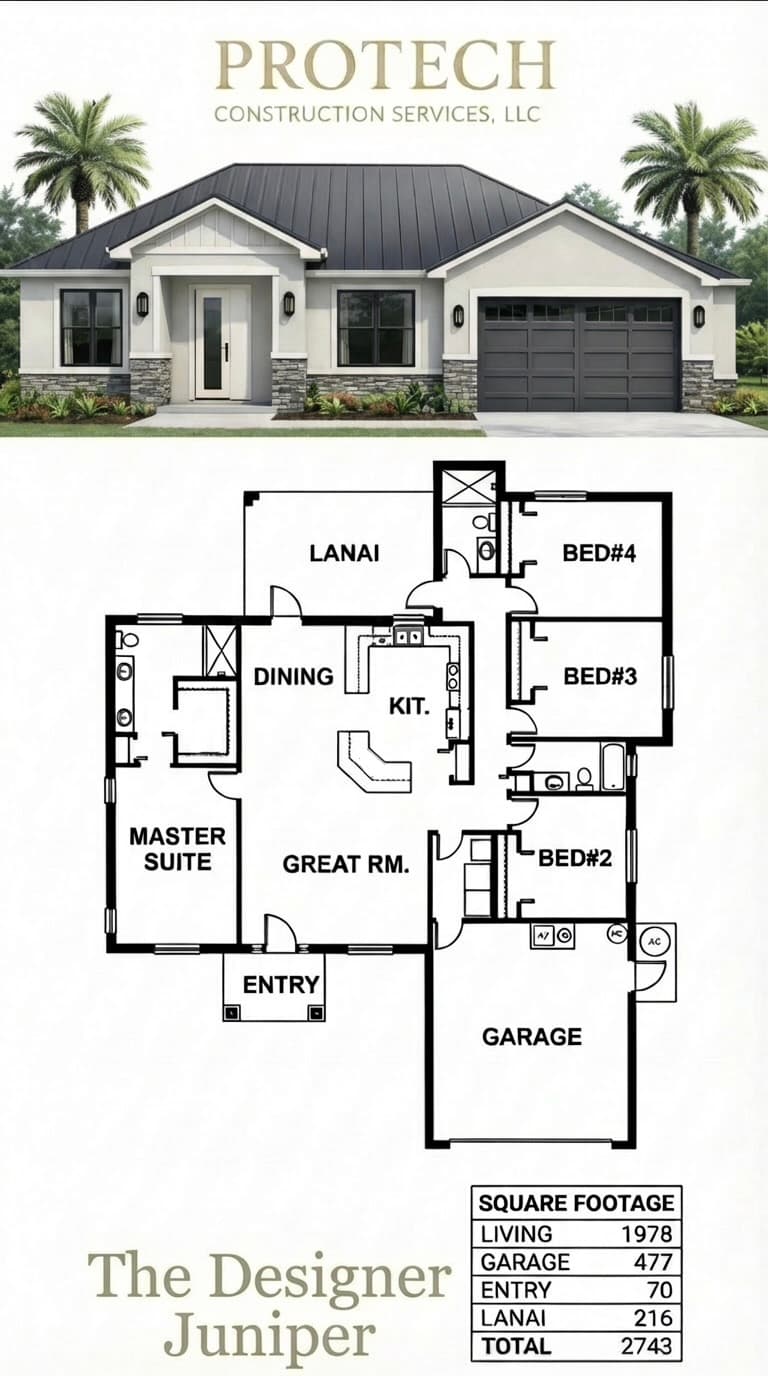
1,978 square feet of living space across 4 bedrooms and 2 baths, finished with a standing-seam metal roof, modern stone columns, and a covered entry. Built to FBC 8th Edition wind code in Hernando, Pasco, and Citrus counties.
Call (352) 710-54554
Bedrooms
2
Bathrooms
2-Car
Garage
1,978
Living Sq Ft
Square Footage Breakdown
- Living
- 1,978 sq ft
- Garage
- 477 sq ft
- Lanai
- 216 sq ft
- Covered Entry
- 70 sq ft
- Total
- 2,741 sq ft
The Designer Juniper is for the family that wants the full 4 bedroom Juniper floor plan and a more architectural exterior than a typical Florida shingle ranch. Same livable interior. Standing-seam metal roof, deeper covered entry, modern stone columns, and a contemporary two-tone stucco package on the outside.
It is a strong fit for a buyer comparing new builds against LGI Royal Highlands and the other production communities around Brooksville and Spring Hill, where prices start around $295,900 for a stock spec home on a small lot. With the Designer Juniper you get a true custom build, your own land, the larger 1,978 square foot footprint, and an exterior that holds its value at resale instead of looking like every other shingle ranch on the block. The metal roof also brings a measurable insurance credit and a 50-plus year service life, which is the part most buyers do not learn about until their second insurance renewal.
The buyer who lands here is usually one of three profiles. A growing family that needs four real bedrooms and wants the curb appeal to match the school-pickup driveway. A second-time buyer moving up from a starter home in Spring Hill who is tired of asphalt-shingle re-roofs and wind premium creep. A retiree relocating from the Northeast who already lived under a metal roof up there and is not interested in giving that up just because they crossed the state line. All three end up on the same page once they see the wind mitigation math.
The Floor Plan
The Designer Juniper layout at a glance
The Walkthrough
Walking through the Designer Juniper
Same 4 bedroom Juniper interior
The interior of the Designer Juniper is identical to the standard Juniper. Master suite on the far left of the home, three secondary bedrooms (Bed 2, Bed 3, Bed 4) along the right wing in a row, great room and open kitchen and dining centered between them, and a 216 square foot covered lanai stretching across the back. The 2-car garage anchors the bottom-right of the plan with its door facing the front of the lot. If you want the full room-by-room interior walkthrough, read the standard Juniper page. The square footage, the sightlines, the closet placements, and the laundry layout are the same on both plans.
The headline interior numbers: 1,978 square feet of conditioned living space, four real bedrooms (not a study with a closet jammed in), two baths, a walk-in master closet sized for two adults, a dedicated pantry, and an interior laundry. The kitchen island faces the great room so the cook stays in the conversation. Every Juniper bedroom has at least two windows for cross-breeze and natural light.
Standing-seam metal roof
The headline exterior change is the roof. The Designer Juniper swaps the architectural shingle for a 24-gauge standing-seam metal roof, mechanically seamed at the rib, fastened to a glued and ring-shank-nailed plywood deck, over a synthetic high-temperature underlayment. The panels are factory-painted Kynar 500 in your color choice. The system is rated to FBC opening protection and uplift requirements and qualifies for the wind mitigation credit on most Florida homeowners policies. Service life is 50-plus years versus 25 to 30 for a typical shingle, which means you avoid an entire re-roof event over the life of the home.
From the curb the standing-seam reads as long, clean vertical lines running from the ridge to the eave. The seams catch shadow at sunrise and sunset, which is why the exterior photographs so much better than a shingle ranch. The hip lines and ridge caps are factory-finished to match the panel color, no exposed flashing trying to pretend it belongs there. Eaves and rakes get a closed-cell foam closure to keep wind-driven rain and pests out of the panel cavity, a detail that some Florida metal installers skip and end up regretting.
Modern stone columns and a deeper covered entry
The standard Juniper covered porch grows into a deeper covered entry on the Designer package. Two stone-wrapped columns frame the entry, the soffit detail is upgraded with a darker accent, and the front door package includes a modern oversized slab. The deeper roof line over the entry handles afternoon storms and pulls a larger architectural shadow line across the front elevation. From the curb, the front of the home reads as a 2026 custom build, not a 1990s tract ranch.
The stone wrap is real adhered stone veneer over a metal lath and scratch coat, not foam product painted to look like stone. We pour a separate column footing tied into the slab, then build the column shell, lath it, and adhere the stone face. The result holds up to Florida humidity, salt-laden air, and the occasional hurricane debris hit, while a foam product would chip and discolor inside five years. The column caps are precast concrete in a color matched to the trim, and the bases sit on a poured concrete plinth that lifts the stone above the splash line so it reads clean from the driveway.
Contemporary two-tone stucco and trim
The exterior color package runs in two tones. A primary body color across the main wall planes (warm white, soft gray, or beige), and an accent color on the front entry wall and gable returns (charcoal, matte black, or dark bronze). Window and door trim is a clean rectangular profile in a contrasting finish, no foam scrollwork. The garage door upgrades to a horizontal-line modern panel design instead of the standard short-panel raised pattern. Soffit, fascia, and gutter profiles are color-matched to the trim instead of left builder-white.
The stucco itself is a three-coat system over the CMU walls: scratch, brown, and color finish. We integrate the pigment into the finish coat instead of painting over a builder-grade gray, which means the color does not chalk or peel the way painted stucco does after five Florida summers. Touch-up over a 20-year ownership is a quick patch and matched finish, not a full repaint. The accent color sits on the front entry wall and the gable returns in a flat, modern finish, with a clean reveal trim where it meets the body color so you do not get a ragged transition line.
Lanai across the back
The 216 square foot covered lanai runs across the back of the great room and master suite, same as the standard Juniper. You can keep it open, screen it in for the bug season, extend it with pavers, or step it up to a full outdoor kitchen package during customization. The lanai roof line carries the metal roof finish to keep the back of the home consistent with the front.
The lanai posts on the Designer package match the front entry stone columns at a lighter scale, so the back of the home reads as a piece of the same exterior package and not a builder afterthought. Owners who add the outdoor kitchen rough-in usually run gas and water through the back wall during framing, plus a 240V circuit if they plan to drop in an electric grill or pizza oven. We map all of those rough-ins at the selection meeting so the slab pour and the wall framing both land in the right spot.
The exterior story in one line
You are paying for an exterior that holds its value, an insurance line item that shrinks every renewal, and a roof you will probably never have to replace. The Juniper interior is along for the ride.
Built for Florida
Engineered for Hernando County wind, weather, and water
The Designer Juniper carries every structural detail from the standard Juniper, plus the metal roof system that drives most of the wind mitigation conversation. Engineered to the 8th Edition Florida Building Code, ASCE 7-22 wind loads, Wind Zone 3, with a design wind speed range of 150 to 160 mph for Risk Category II residential.
Standing-seam metal roof and the wind mitigation credit
The metal roof is the core selling point and it earns its place. The standing-seam panel system is mechanically seamed at the rib, fastened through concealed clips to a glued and ring-shank-nailed plywood deck, and laid over a synthetic high-temperature underlayment that doubles as secondary water resistance. That entire stack scores well on the OIR-B1-1802 wind mitigation form. Most Florida carriers translate that score into a discount of roughly 30 to 40 percent off the windstorm portion of the policy. On a typical Hernando County premium that is real money every year, year after year, for as long as you own the home.
Service life is the second part of the math. A correctly installed standing-seam metal roof carries a 50-plus year expected service life under Florida sun, salt air, and storm cycles. A 30-year architectural shingle in the same conditions realistically lasts 22 to 28 years. Over a 30-year ownership, the Designer Juniper owner avoids one full re-roof event that the shingle owner does not.
The wind mitigation form itself is worth a paragraph, because most owners do not see one until their first renewal. The OIR-B1-1802 inspection looks at seven categories: building code, roof covering, roof deck attachment, roof-to-wall connection, roof geometry, secondary water resistance, and opening protection. A Designer Juniper with the standing-seam roof, glued and ring-shank-nailed sheathing, hurricane straps at every truss, a hip roof geometry, the synthetic underlayment, and impact-glass windows hits the top tier on every line. That is the form a carrier wants to see and it is the form that produces the largest credit.
One detail most metal roof advocates miss: the credit is not automatic. You pay for the inspection (roughly $100 to $150 in Hernando County), and you submit the report to your carrier or your independent agent at the next renewal. Once it is on file, the credit applies for as long as the roof is on the home. If a hurricane damages the roof and a like-for-like replacement happens under your insurance claim, the form stays valid.
Concrete block walls and a monolithic slab
Exterior walls are 8-inch CMU with reinforced cells at every corner and opening, finished in stucco. The foundation is a monolithic slab on grade engineered for Hernando County's soil and water table. No crawl space, no termite-bait wood subfloor, no second story to add wind exposure.
Engineered roof structure tied to the walls
The roof structure under the metal panels is the same engineered truss system that carries the standard Juniper. Hurricane straps at every truss-to-wall connection, glued and ring-shank-nailed sheathing at upgraded spacing, and a continuous load path from the ridge to the slab. The metal panels sit on top of that structure, not in place of it.
Windows and the impact upgrade
Standard windows are single-hung, low-E, and rated to the FBC opening protection requirements with shutters or panels. Most Designer Juniper owners upgrade to laminated impact glass during customization. That removes the need for shutters, layers another wind mitigation credit on top of the metal roof credit, and finishes the modern look from the curb.
Energy and efficiency built in
HVAC is sized to the conditioned envelope. Attic insulation is R-30 base with R-38 available. Air handler lives in conditioned space, not the hot attic. The light-colored metal roof options reflect more solar heat than a dark shingle, which trims the cooling load through Florida summers. Energy-Star appliances and a tankless water heater are the two upgrade boxes most owners check during customization.
If you are budgeting for a future solar array, the metal roof pays a third dividend. Standing-seam panels accept rail-less S-5 clamp mounting, which means a solar installer can clip racking directly to the seams without a single penetration through the roof. No drilled holes, no flashing, no sealant that fails in eight years. The mounting hardware comes off cleanly when the panels are eventually replaced or upgraded. Most shingle solar installs require dozens of penetrations, and most Florida shingle owners discover during a roof replacement that they have to pay to remove and remount the array. Designer Juniper owners do not.
What’s Included
What’s in your Designer Juniper build
The Designer Juniper base specification covers everything you would expect on a real custom build, plus the full Designer exterior package. No production-builder shell, no $40,000 list of "options" tacked on at the design center after you sign.
The base spec below is what shows up on every Designer Juniper, on every lot, in every county we build. The contract you sign is the contract we build to. If you want to go richer on a category (heavier stone, premium quartz, impact glass on every opening), those step-ups are priced at the selection meeting and locked into the same fixed contract. If you do not, the base spec is a complete house, not a sales tease.
Site and structure
- Site preparation: Clearing, grading, fill, compaction, and silt fencing per Hernando County permitting.
- Foundation: Engineered monolithic slab on grade with reinforcement.
- Exterior walls: 8-inch CMU with reinforced cells, smooth or knockdown stucco finish, two-tone color package.
- Roof system: Engineered trusses, hurricane straps, glued and nailed sheathing, 24-gauge standing-seam metal roof in Kynar 500 finish.
- Front entry: Deeper covered entry with stone-wrapped columns and an oversized modern door.
- Windows: Single-hung low-E with code-compliant opening protection. Laminated impact glass upgrade available.
- Garage door: Horizontal-line modern panel design, color-matched to the trim package.
Interior finishes
- Cabinets: Wood construction with soft-close drawers from a curated finish palette.
- Countertops: Quartz or granite from the standard selection.
- Appliances: Stainless range, dishwasher, microwave, and disposal.
- Flooring: Tile in main living areas, kitchen, and baths. Carpet in bedrooms with hardwood or LVP available as an upgrade.
- Trim and doors: 5 1/4-inch baseboard, raised-panel interior doors, lever hardware.
- Lighting and electrical: Recessed LEDs in living spaces, ceiling fan rough-ins in all four bedrooms and the great room, pre-wire for the front entry and the lanai.
Mechanical and warranty
- HVAC: 14 SEER central system sized to the conditioned envelope, with a programmable thermostat.
- Plumbing: Standard fixture package, gas or electric water heater, hose bibs front and rear.
- Insulation: R-30 attic, foam-sealed top plates, fully insulated exterior walls.
- Builder warranty: 1-year workmanship, 2-year systems, 10-year structural through our third-party warranty partner.
Make It Yours
Customization options
The Designer exterior is the baseline on this plan. Everything below is what you stack on top of it during the selection meeting. Every Designer Juniper we build is a real custom, not a model home with three trim packages.
The way we run the selection meeting matters as much as the options themselves. You sit down with your project manager and your designer in our Brooksville office for three to four hours, every selection on the table at once. Cabinet door sample, countertop slab photo, tile board, plumbing fixture finish, paint chip, metal roof color sample, stone column profile, garage door brochure, and the floor plan with red-line space for adjustments. By the end of the meeting your contract is fixed, not estimated. No phantom selection charges later, no design center upsell that surprises you at framing.
Exterior step-ups
- Heavier stone wrap that runs across the full front elevation instead of just the entry columns
- Wood-look fiber cement accent panel at the front entry wall
- Premium Kynar 500 metal roof colors (deep red, dark green, copper-look) and matching gutter profiles
- Laminated impact glass on every window for shutterless opening protection
- Oversized modern garage door with frosted glass insert row
- Outdoor uplighting on the stone columns and a soffit-mounted accent strip across the entry
Kitchen and baths
- Cabinet color, door style, and hardware finish
- Countertop selection across the standard quartz and granite palette, with a premium upgrade option
- Backsplash tile, pattern, and grout color
- Plumbing fixture finish: chrome, brushed nickel, matte black, or champagne bronze
- Master shower configuration: enclosed, glass-only, or zero-entry
Floor plan adjustments
- Master suite extension over the lanai for a sitting area
- Convert Bed 4 to a study with a French-door entry from the foyer
- Add a pocket office between the great room and Bed 2
- Screen the lanai or extend it with pavers
- Add an outdoor kitchen rough-in along the back wall
Smart and energy upgrades
- Whole-home smart home pre-wire
- Solar-ready roof with conduit and main-panel space reserved (the metal roof system pairs cleanly with rail-less solar mounting)
- R-38 attic insulation upgrade
- Tankless water heater
- EV charger circuit pre-installed in the garage
Where We Build
Building the Designer Juniper across three counties
We build every plan, including the The Designer Juniper, on owner-supplied lots and on land we help you find across:
From Plan to Keys
How a Designer Juniper build actually goes
The path from your first call to the day you turn the key is a known process, not a mystery. Here is what it looks like with Protech.
- Plan packet review. You request the Designer Juniper Plan Packet from this page. It arrives in your inbox with the floor plan, the Designer exterior package details, included features, customization options, and a build timeline.
- Free consultation. We meet at your lot, your home, or our office in Brooksville for about an hour. You bring questions, we bring honest answers about budget, timeline, the wind mitigation credit math, and what the Designer Juniper will look like on your specific lot.
- Lot evaluation. If you already own land, we visit the lot to check soil, access, setbacks, and HOA conditions, plus confirm the deeper front entry fits the front setback. If you do not have land yet, we point you toward what is moving in Hernando, Pasco, and Citrus.
- Plan customization meeting. We walk through every selection together, lock in your finishes, exterior color package, metal roof color, and floor plan adjustments, and produce a fixed-price contract.
- Permit submittal. Plans go to the Hernando County Building Division. Plan review currently runs 10 to 21 days depending on workload, with permits issued shortly after.
- Loan close. If you are using a construction-to-permanent loan, the single closing happens here. One loan, one set of paperwork, and the lender pays the builder in draws as we hit milestones.
- Site work and slab. Clearing, grading, footers, plumbing rough, and slab pour. Three to four weeks.
- Vertical construction. Block and tie beam, truss set, dry-in, metal roof install, mechanicals, drywall, finishes, cabinets, and countertops. Six months.
- Wind mitigation inspection. An independent inspector documents the metal roof, the truss tie-downs, the opening protection, and the rest of the wind mitigation form. Your insurance carrier uses that report to apply the credit at the first renewal after move-in.
- Final inspections and walkthrough. County inspector, our project manager, and you. Punch list gets handled before close.
- Certificate of Occupancy and keys. You move in.
Total runway from contract to keys for a typical Designer Juniper build is nine to eleven months. We give you a real schedule, not a marketing one.
Two notes on the schedule that matter for Designer Juniper buyers specifically. First, the metal roof install adds about a week compared to a shingle install at the dry-in stage, because the panels are run continuous from ridge to eave and the trim work is detailed by hand. We schedule the metal subcontractor early so the roof is on before the interior trades start, which keeps the rest of the schedule on track. Second, the wind mitigation inspection at step nine should not be skipped. Some owners assume the carrier will figure it out from the permit record. They will not. Pay the $100 to $150, get the form on file, and the credit shows up at the next renewal cycle.
Compare
Other plans worth a look
Pair: Standard exterior
The Juniper
If the metal roof premium and the modern exterior package are not the part of the budget you want to spend on, the standard Juniper is the same floor plan with a 30-year architectural shingle, traditional stucco, and a standard front porch. You keep all 1,978 square feet of the 4 bedroom interior, the lanai, and the 2-car garage, and you save the Designer exterior cost. Easy way to put more of the budget into kitchen finishes, the lanai upgrade, or the lot itself.
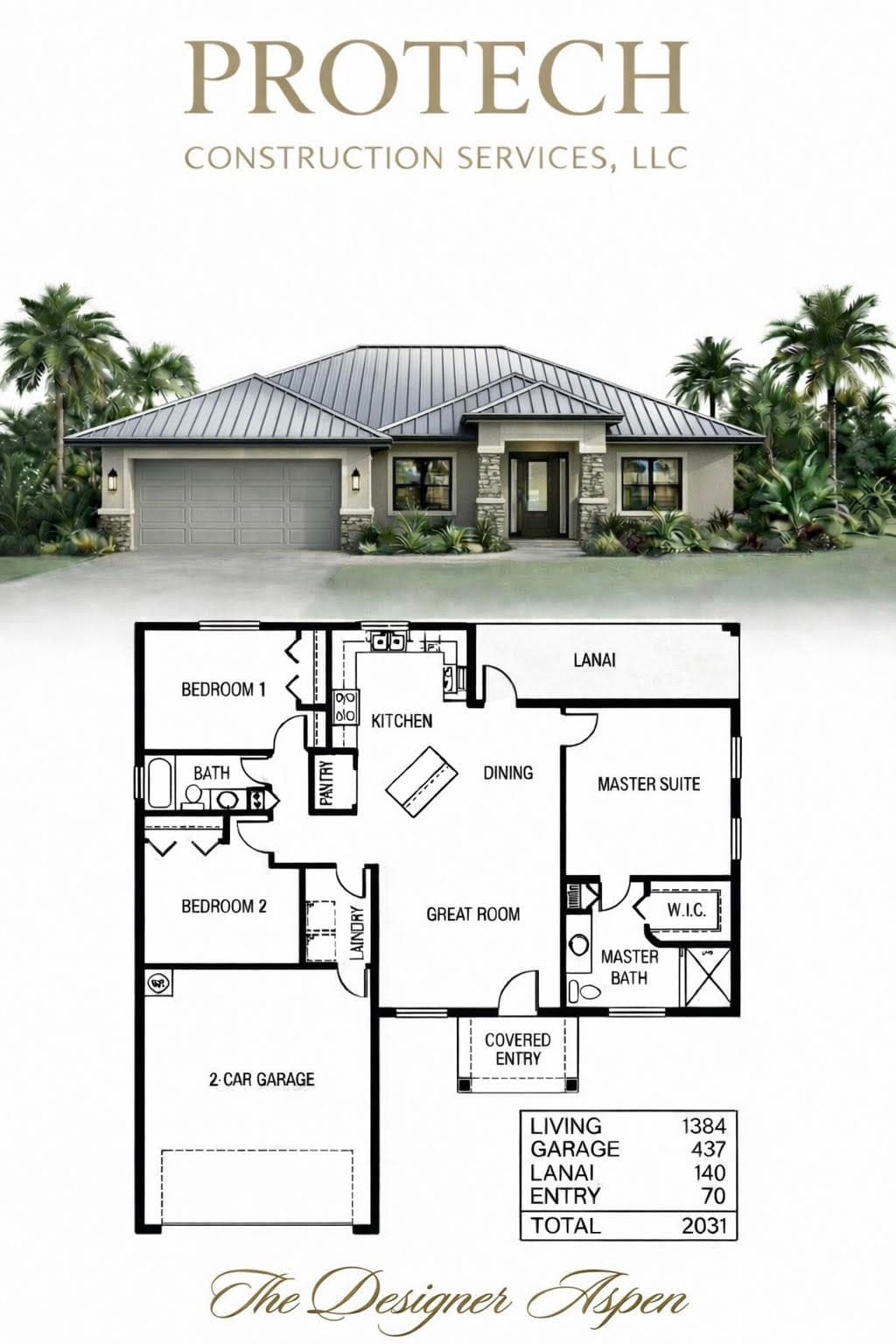
3 BR · 2 BA · 1,384 sq ft
The Designer Aspen
Single-story 3 bedroom, 2 bath custom home with the Aspen's split-bedroom layout, an upgraded standing-seam metal roof, and modern stone columns. 2,031 total square feet on a Hernando County lot, with a wind mitigation insurance credit built in.
See The Designer Aspen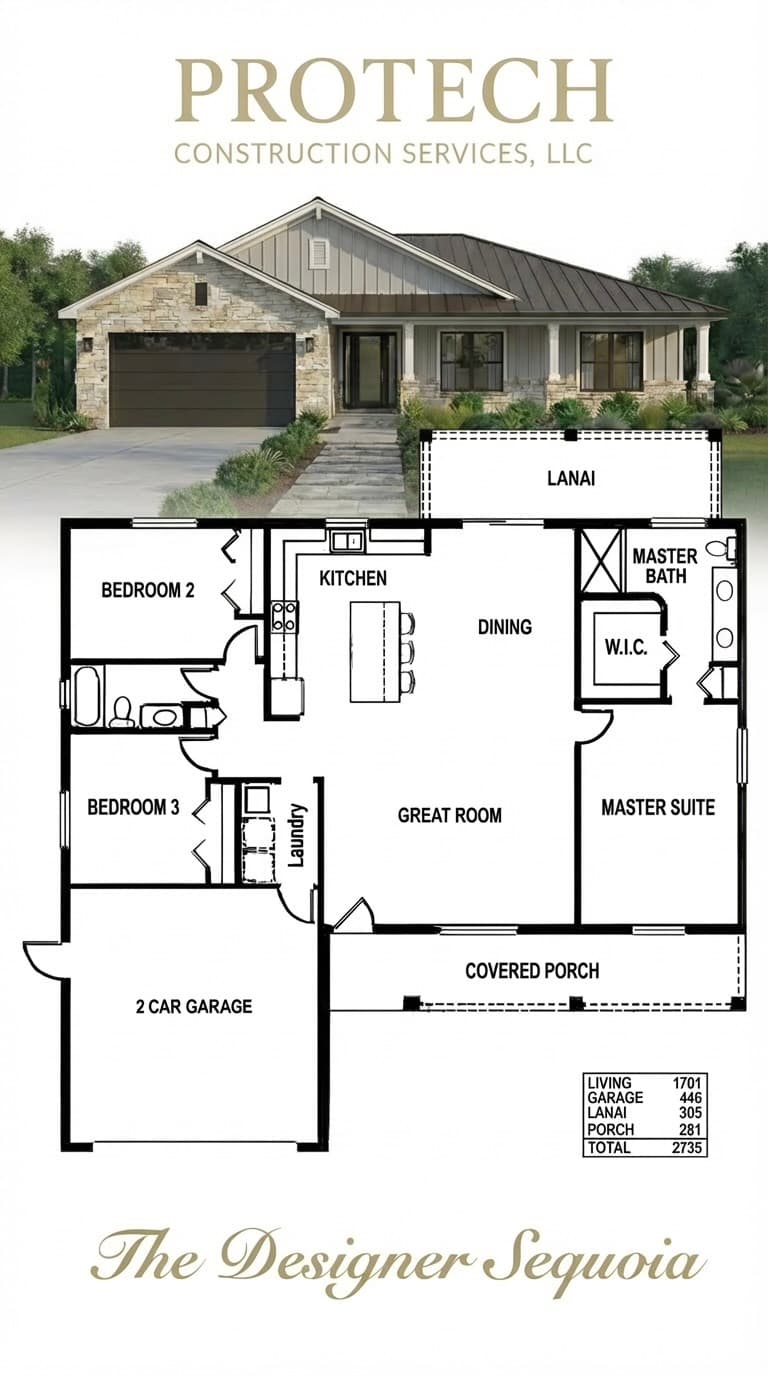
3 BR · 2 BA · 1,701 sq ft
The Designer Sequoia
Single-story 3 bedroom, 2 bath modern farmhouse home with board-and-batten siding, stone column accents, standing-seam metal roof, covered front porch, and rear lanai. 2,733 total square feet on a Hernando County lot.
See The Designer SequoiaPlan Packet
Get the full Designer Juniper Plan Packet
Floor plan, included features, customization options, build areas, and our 8-to-10 month timeline. Sent to your inbox within minutes.
Ready to Build?
Break ground on your free Designer Juniper consultation today.
No-pressure 1-hour walkthrough at your lot, your home, or our Brooksville office. We answer every question. You decide what is next.
FAQ