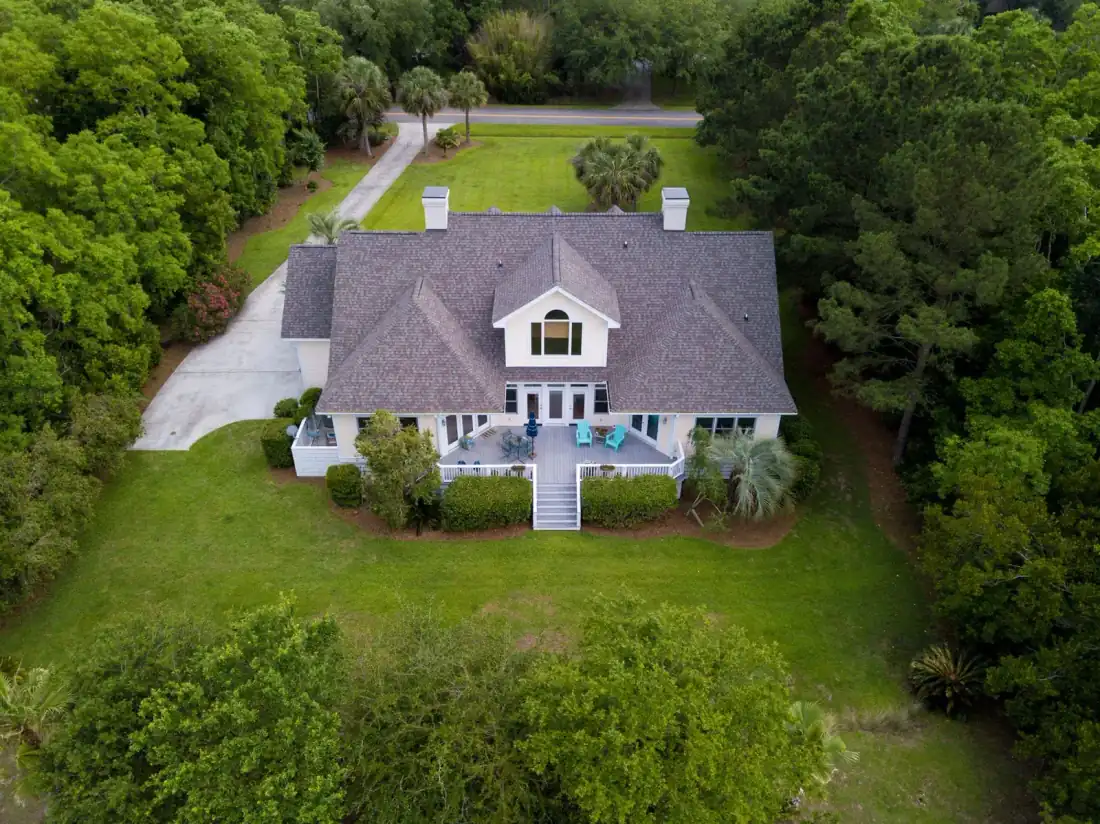
Most people shopping for land in Hernando County price it the way they price a house: dollars per acre, road frontage, how the drive feels. Then they close, bring in a builder, and discover that the parcel needs a well at 340 feet, a mound septic system because the water table sits high, 900 feet of driveway with a culvert, and a geotechnical report because the neighbor two lots over had a subsidence claim. None of that was hidden. All of it was findable before closing. This guide covers what to verify on a Brooksville area lot, in what order, and what each item realistically costs, so the parcel you buy is the parcel you think you are buying.
The Lot Is the One Decision You Cannot Undo
Everything else in a custom build is revisable. You can move a wall while the plan is still on paper, change cabinet species before the order goes in, swap a builder if the relationship sours. The land is different. Once you close, the soil under it, the depth to water, the flood zone designation, and the distance to the nearest utility are permanent inputs to every number that follows.
That matters more in Hernando County than in most of Florida, for one geological reason. This is karst country. The limestone bedrock under Brooksville, Spring Hill, and Weeki Wachee dissolves in slightly acidic groundwater, which over geologic time creates the springs and caves the region is known for, and on a shorter timescale creates subsidence and sinkholes. Florida leads the nation in documented sinkholes, and Hernando sits among the highest risk counties alongside Pasco, Hillsborough, Marion, and Pinellas.
None of that makes Hernando a bad place to build. People build here successfully every week, and the county is one of the better values on the Nature Coast. It does mean that the due diligence that a buyer in a platted subdivision on sand can safely skim is diligence you should actually perform here. The rest of this guide is that list.
Karst: What the Limestone Under Your Lot Means
Karst terrain forms where bedrock dissolves, producing underground drainage that shows up at the surface as sinkholes, springs, disappearing streams, and caves. Two consequences matter to you as a buyer.
- Structural risk: Voids in the limestone can migrate upward through overlying sediments until the surface subsides. Activity is cyclical and increases during the rainy season, when more than twice as many sinkholes occur, because infiltrating water accelerates the process.
- Groundwater vulnerability: Percolation happens fast in karst, so contamination reaches the aquifer more readily than it does through dense clay. This is precisely why septic setbacks are enforced strictly here and why well placement is not a matter of convenience.
What to actually do about it before you close:
- Check the public record first, at no cost: the Florida Geological Survey sinkhole database, the Florida Department of Environmental Protection OCULUS permit database, and the seller property disclosure. A prior insurance claim or remediation on the parcel or its immediate neighbors is the single most useful thing you can learn early.
- Order a pre purchase assessment if the record raises anything: a sinkhole survey by a licensed geologist typically runs about $500 to $1,500, and geotechnical assessment in the sinkhole prone parts of Hernando and Pasco commonly adds $500 to $1,500 to a project.
- Ask about insurability, not just stability: a parcel with claim history in the neighborhood can be structurally buildable and still complicate the carrier conversation later. It is cheaper to learn that during a due diligence period than after closing.
A geotechnical report is also what lets a builder engineer a foundation correctly rather than conservatively guessing. That report frequently pays for itself, because the alternative is over specifying footings on a lot that never needed it. This is exactly the kind of input our construction management team wants in hand before the first plan revision.
Water: Utility Connection or Private Well
Ask this question before you make an offer, because the answer swings tens of thousands of dollars. Some Hernando parcels sit on county water. Many rural ones do not, and roughly 12 percent of households in the county rely on private wells.
If the lot needs a well, here is the realistic picture:
- Permit: A Well Construction Permit from the Southwest Florida Water Management District is required before installation, and the well must be drilled by a licensed contractor. Permit costs in Florida generally fall in the $100 to $400 range.
- Depth: Wells into the confined Floridan Aquifer typically run somewhere between 100 and 500 feet depending on location, and depth is the main driver of price.
- Drilling cost: Most Florida contractors charge roughly $8 to $20 per foot, with the lower half of that range common in north and central Florida. Statewide, 2026 well projects run about $3,000 to $16,000 with a median near $7,000.
- Treatment, which nearly everyone forgets: Almost every Florida well needs $2,000 to $5,000 of treatment equipment for hydrogen sulfide, iron, hardness, or some combination. Nature Coast water is frequently hard and sulfurous. Budget it as part of the well, not as an upgrade.
The practical move is to ask neighbors on adjacent parcels how deep their wells went and what treatment they installed. Well depth is highly local, and the house across the road is a better predictor than any regional average.
Sewer or Septic, and the Setback That Sizes Your Lot
Where county sewer is unavailable, you are installing an onsite sewage treatment and disposal system, and its required setbacks quietly determine how much of your land is actually usable. In Hernando County the Florida Department of Health continues to handle permitting and inspection for septic systems, an arrangement retained after the 2021 program transition that moved regulatory oversight to the Department of Environmental Protection under the Clean Waterways Act of 2020.
The setbacks that shape a site plan:
- 75 feet from a private drinking water well, measured from any part of the system, tank and drainfield alike.
- 200 feet from a public drinking water well.
- 75 feet from surface water.
- 5 feet from property lines and 5 feet from buildings.
- 10 feet from stormwater ponds.
Now picture those circles overlaid on a parcel. On a lot served by its own well, you need a house footprint, a drainfield, and a wellhead that all keep 75 feet between the sewage system and the well while respecting every other setback. That is why parcels relying on private wells generally need at least a half acre, and often a full acre, depending on zoning and soil conditions. A narrow one acre strip can be harder to lay out than a square half acre, which is a distinction raw acreage on a listing never shows.
Two procedural details worth knowing: site plans and floor plans submitted for septic permitting must be no larger than 11 by 17 inches, and since July 1, 2022 property owners may hire a private provider to perform inspections rather than waiting on county scheduling. Permits are paid through the state portal and inspections are scheduled through the county system, with requests submitted by the certified provider rather than the homeowner. The Hernando County health department environmental office can be reached at 352-540-6812.
Soil is the other half of this. If the water table is high or the soil percolates poorly, the answer is a mound or performance based system rather than a conventional drainfield, which costs meaningfully more and sits visibly higher on the lot. A soil evaluation tells you which system the parcel will require, and it is the single most valuable test you can run during due diligence.
Zoning, Setbacks, and What to Ask the County
Zoning determines what you may build, and it is not always what the seller believes it to be. Verify directly with Hernando County rather than relying on a listing description.
- Zoning designation and minimum lot size, plus whether the parcel meets it or is a legal nonconforming lot.
- Front, side, and rear setbacks, and maximum lot coverage. On a narrow parcel these can rule out a plan you already fell in love with.
- Maximum building height and accessory structure rules, if a workshop, detached garage, or guest suite is part of the plan.
- Deed restrictions and any HOA, which are separate from zoning and frequently stricter. Restrictions run with the land and survive the sale.
- Impact fees, which are assessed at permit and are a real four to five figure line item. Hernando updated its impact fee schedule in recent years, so confirm the current figure at the time you pull the permit rather than relying on an older number.
If the plan you want and the lot you found are not compatible, that is worth discovering now. Our custom floor plan work regularly starts from a parcel's constraints rather than a catalog page, and the available floor plans list the footprints to check against your setbacks.
Flood Zone, Wetlands, and Elevation
Pull the FEMA flood map for the parcel and read the zone designation before you write an offer. A lot in a Special Flood Hazard Area is still buildable, but it changes three things at once: the required finished floor elevation, the cost of the foundation to reach it, and the flood insurance premium for as long as you own the house.
Wetlands are the other mapped constraint. A jurisdictional wetland on the parcel does not necessarily prevent building, but it reduces the buildable envelope and can require agency review that adds months. If the listing photos show standing water, cypress, or the parcel is unusually cheap for its size, treat that as a question rather than a bargain.
Elevation and drainage also interact with the septic answer above. A high seasonal water table is common across the Nature Coast, and it is the most frequent reason a lot needs an elevated drainfield.
Access, Power, and the Costs Nobody Budgets
These items rarely appear in a land listing and routinely surprise buyers at the first real estimate.
- Legal access: Confirm the parcel has frontage on a maintained public road or a recorded easement. A verbal understanding that you may cross a neighbor's land is not access, and lenders treat it accordingly.
- Driveway and culvert: A long approach on an unimproved parcel is its own construction project, and a driveway crossing a drainage swale needs a properly sized culvert and a county permit.
- Power drop distance: The utility will run service a certain distance at standard cost and bill you for the excess. On a deep rural parcel that overage can be substantial, so ask the utility for a written estimate rather than assuming.
- Clearing and grubbing: Wooded acreage has to be cleared, stumps removed, and debris hauled or burned under permit. Mature oaks may also be protected depending on the ordinance.
- Survey: A current boundary survey is non negotiable. Old fence lines and mowing habits are not property lines, and this is how encroachments surface before they become disputes.
The Due Diligence Order That Saves Money
Sequence matters, because each step can end the process before you spend on the next one.
- First, free desk research: zoning, flood zone, FEMA map, sinkhole databases, property appraiser records, seller disclosure. An afternoon, no cost, and it eliminates a meaningful share of parcels.
- Second, utility availability calls: water, sewer, and electric. Free, and it determines whether you are budgeting a connection or a well plus septic.
- Third, get the contract with a due diligence period long enough to complete testing, and make it contingent on satisfactory results.
- Fourth, order the survey and the soil evaluation. These two answer where the house can sit and what septic system the lot requires.
- Fifth, add geotechnical or sinkhole assessment if the desk research or the neighborhood history flagged anything.
- Sixth, walk the parcel with your builder before the contingency expires, with all of the above in hand.
That last step is the one buyers skip most often and regret most reliably. A builder walking a lot reads the grade, the tree line, the approach, and the neighbors' systems, and translates them into a number. Bringing us out during due diligence rather than after closing is free advice at the moment it can still change your decision. We build throughout Brooksville and Hernando County, and new construction in Brooksville starts with exactly this conversation.
Red Flags That Should Change Your Offer
- Priced well below comparable parcels with no obvious explanation. There is usually a reason, and it is usually wetlands, access, or a failed prior test.
- Seller cannot produce a survey and resists you ordering one during the contingency period.
- No recorded access easement where the parcel does not front a maintained road.
- Neighboring parcels with subsidence or remediation history in the public record.
- Standing water present in the dry season, which suggests a water table problem that gets worse in summer.
- A previously permitted septic system that was never installed, or a lapsed permit, which often means a soil evaluation came back poorly.
- Deed restrictions that conflict with your plan, such as minimum square footage, exterior material requirements, or a ban on detached structures.
None of these are automatic disqualifiers. Every one of them is a reason to price the parcel differently or to extend the contingency period until you know the answer.
What This Costs You to Find Out
The full due diligence package on a Hernando County lot, survey plus soil evaluation plus a geotechnical or sinkhole assessment where warranted, lands in the low thousands. Against a custom home budget it is a rounding error, and it is the only money in the entire project that reliably prevents a much larger number later.
Put the other way: the difference between a good lot and a difficult one in this county is frequently $30,000 to $60,000 in well depth, elevated septic, driveway, power run, and foundation engineering. That difference is fully knowable before closing, and almost none of it is visible on a drive by.
Once the lot checks out, the cost conversation becomes a normal one, and the current numbers for this market are in our guide to the cost to build a custom home in Hernando County. The schedule side is covered in how long it takes to build a house in Florida, and what the structure has to meet is in our breakdown of the Florida hurricane wind code for new homes.
Protech Construction Services is a licensed general contractor, CBC1268979, based at 9035 Jayson Dr, Brooksville FL 34613. If you have a parcel under consideration, call (352) 710-5455 and we will walk it with you before your contingency period runs out. Ready to price a build on land you already own? Start with custom home building.
FAQ
Frequently Asked Questions
How much land do you need for a well and septic system in Florida?
+
What does it cost to drill a well in Hernando County?
+
Should I get a sinkhole inspection before buying land in Hernando County?
+
Who issues septic permits in Hernando County?
+
What should I test before closing on a building lot?
+
Can I build on a lot in a flood zone in Florida?
+
Keep Reading
More articles from the Protech Construction blog
Bathroom Remodel Cost in Brooksville FL 2026: Why the Drain Decides Your Budget
A Brooksville bathroom remodel runs roughly $13,500 to $35,000 in 2026, and the single line item that decides where you land is whether the drains move. Here is the real math, the slab problem, the permit picture, and the surprises older homes hide.
Read Article
Kitchen Remodeling in Brooksville FL: What to Expect in 2026
Kitchen remodels in Brooksville run $25,000 to $95,000 in 2026. Here is exactly where the money goes, how long it takes, what Hernando County permits require, and how to avoid the surprises that blow budgets.
Read Article
How to Choose the Best General Contractor in Brooksville FL
Hiring the wrong general contractor in Brooksville can cost you your home, your savings, and years of stress. Here is exactly how to verify, vet, and protect yourself before you sign anything.
Read ArticleReady to Build?
Get your free evaluation today.
No-pressure consultation. We serve Hernando, Pasco, and Citrus counties. Call us now or request a visit online.