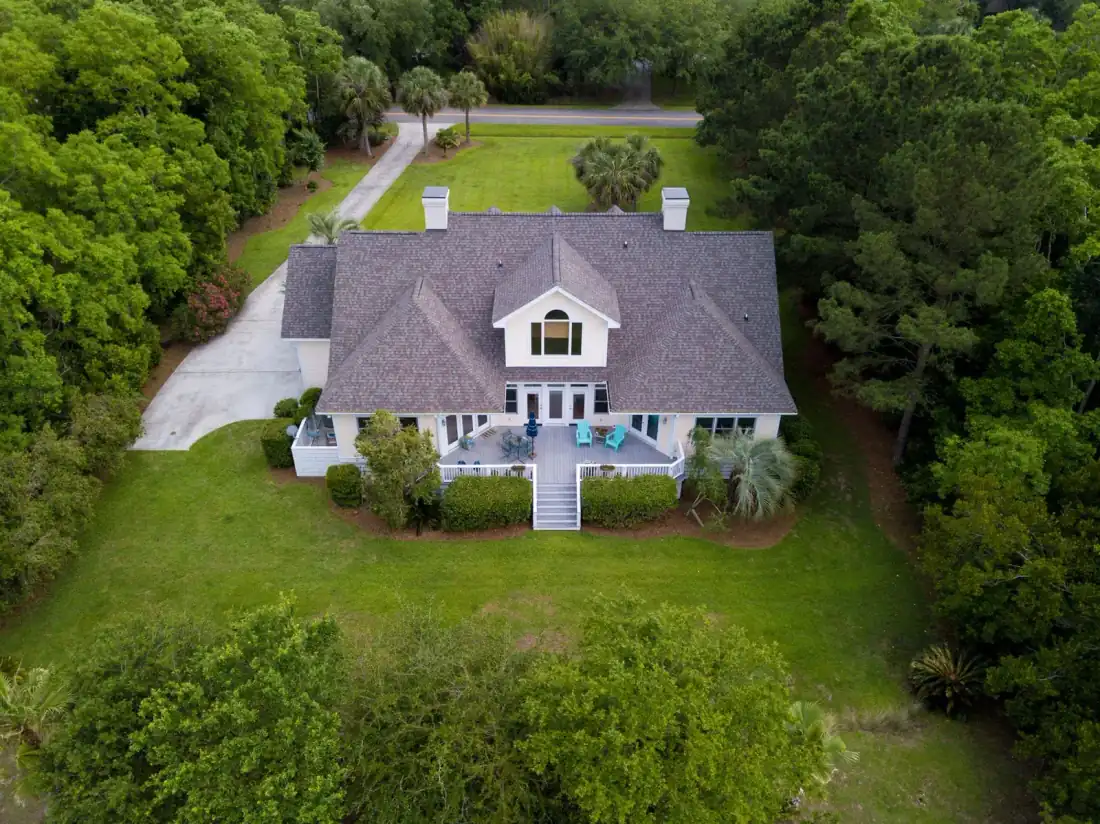
Every Florida homeowner eventually gets the hurricane hardening conversation, and it almost always happens at the wrong moment: after a storm, with a finished house, when every upgrade means opening something that is already closed. The version of that conversation worth having happens years earlier, at the framing plan, and it costs about a quarter as much. This is the arithmetic of why, with 2027 numbers for Hernando, Pasco and Citrus County builds.
The Ratio Nobody Puts in the Brochure
There is a number in the resilience literature that should change how Florida families think about hurricane hardening, and almost nobody quotes it because it does not sell a product. It compares the same set of upgrades, done at two different moments.
Build hurricane resistance into a new home and the upgrade cost over a standard code-compliant build runs roughly 0.5% to 3% of total construction cost. Build the identical performance into an existing house later and the range is 6% to 16%, depending on the home's condition and how much has to be opened up to get at the structure. Those figures come from the FORTIFIED program work and the contractors who price it, and the ratio between them is the whole argument: the same protection costs roughly a quarter as much when it is designed in rather than cut in.
On a $600,000 build in Hernando or Pasco County, 1% to 3% is $6,000 to $18,000. On the same house retrofitted at year fifteen, 6% to 16% of replacement value is $36,000 to $96,000. In absolute dollars, a full retrofit of roof, connections and openings on a Florida home commonly runs $15,000 to $40,000, and a home that predates 1992 can exceed $60,000 once the crew finds what is actually in the walls.
The reason for the gap is not markup. It is access. Nearly every wind-resistance measure attaches to structure, and structure is buried behind finished surfaces the day the house is done.
Why Access Is the Entire Cost Difference
Walk the same upgrade through both timelines and the arithmetic explains itself.
- Roof-to-wall connections: during framing, a hurricane strap or clip is a stamped metal part and a few nails, installed by a framer who is already standing there. It adds dollars, not thousands. Retrofit the same connection later and you are working from inside the attic in a 130-degree crawl space, one truss at a time, around insulation and ductwork, and often removing soffit and fascia to reach the ends. Strap retrofit alone commonly quotes at $850 to $2,500 depending on access and house size, and that is for a job worth a fraction of that in materials.
- Continuous load path: in new construction, the tie from roof to wall to foundation is a design decision that gets embedded in the framing package and the slab. There is no clean retrofit for a missing anchor at the bottom of a wall. You approximate, and the approximation is what costs money.
- Impact-rated openings: new-construction impact windows run roughly $50 to $65 per square foot. Replacement installations run $55 to $85 per square foot for the same glass, because the crew now has to remove existing units, repair the opening, redo the finish inside and out and reseal to a wall assembly that was not built for it.
- Secondary water resistance: a sealed roof deck is a membrane and labor on bare sheathing at dry-in. As a retrofit it requires stripping the roof covering, which means it is only economical when you were replacing the roof anyway.
- Garage door and door assemblies: in new construction you specify the rated assembly and the opening is framed for it. Retrofit means the rough opening frequently has to be modified to accept a rated unit with correct anchorage.
The pattern is consistent. In new construction you pay for a better part. In a retrofit you pay for demolition, access, repair and refinishing, and the better part is often the smallest line on the invoice.
What Florida Code Already Requires, and Where "Beyond Code" Starts
An honest version of this discussion has to separate two things that get merged in marketing: what the Florida Building Code already forces into your house, and what is genuinely optional hardening.
Florida code is not a low bar. A new home permitted today is engineered to the wind speed map for its specific site, with design pressures calculated from building geometry, height, exposure and enclosure classification, and it requires a continuous load path from roof to foundation. Wind-borne debris regions carry opening protection requirements. This is why post-2002 Florida homes perform so differently from pre-1992 stock in claims data, and it is the baseline the numbers above are measured against. We cover what the wind provisions actually require of a new build in our guide to the Florida hurricane wind code for new homes.
So the "beyond code" menu on a new build in Hernando, Pasco or Citrus County is shorter and more specific than most people expect:
- Sealed roof deck beyond the code minimum: taped or fully self-adhered underlayment so that if the covering blows off, water does not enter. This is the single highest-value item in claims data, because most hurricane loss to an intact structure is water, not wind.
- Enhanced fastening schedule on the roof deck: ring-shank nails at tighter spacing than required. Cheap during framing, effectively impossible later without a tear-off.
- Impact glazing on every opening rather than shutters: code allows either. Impact glass costs more and never requires a human being on a ladder the day before landfall.
- Upgraded garage door: the largest opening in most Florida homes and the most common breach point. Once it fails, the house internally pressurizes and the roof becomes the next thing to go.
- Hip roof geometry over gable where the plan allows: a design decision worth real money in insurance credits and worth nothing at all if you try to change it later.
Notice that three of those five are effectively unavailable as retrofits at any sane price. That is the practical meaning of the cost ratio.
The Insurance Side: What Actually Gets Credited
Wind mitigation credits in Florida are not goodwill. They are calculated from a wind mitigation inspection form, and the credits attach to specific verifiable features, which is precisely why building them in is worth more than describing them.
Carriers commonly offer 10% to 25% premium savings for verified reinforced roof-to-wall connections, and impact-rated opening protection commonly earns 20% to 45% depending on carrier and the rest of the risk profile. Impact window installations are estimated to reduce hurricane damage cost by 60% to 75% against standard glazing, with the installation cost recovered through premium savings in roughly 8 to 12 years on a retrofit.
Run that payback math on the new-construction side and it changes character entirely. If the incremental cost of impact glass on a new build is the difference between $50 to $65 per square foot and standard glazing, rather than a $12,000 to $52,000 replacement project, the same annual premium credit pays it back in a fraction of the time. The credit is identical. The thing being paid back is a quarter the size.
There is a broader public-dollars version of this too. Analysis from the National Institute of Building Sciences found that mitigation saves an average of $6 for every $1 spent through federal mitigation grants, and that adopting up-to-date building code requirements returns on the order of $11 per $1 invested. Those are societal ratios rather than a homeowner's checkbook, but they are the reason state programs exist at all.
My Safe Florida Home: Real Money, Retrofit Only
If you already own an older Florida home, the state program is the single best lever available and it deserves an accurate description rather than a rumor.
My Safe Florida Home is a matching grant: $2 in state funds for every $1 the homeowner contributes, capped at $10,000 per home. In practice that means a $5,000 homeowner contribution maxes out the state match on a $15,000 scope of work. Qualifying upgrades are limited to opening protection, which covers impact windows, impact doors, hurricane shutters and impact-rated garage doors, plus roof improvements including re-roofing, secondary water resistance and hip-roof structural features, plus roof-to-wall connections.
The program reopened for the 2025 to 2026 cycle with $352 million, and the 2026 to 2027 state budget reappropriated more than $405 million in unused funds across My Safe Florida Home and the condo pilot combined. Funding cycles open and close, so the balance and application status on the official program site is the only reliable source on any given week.
Two things matter for the comparison in this article. First, the grant is for existing homes, not new construction, which means the state is effectively subsidizing the expensive path because the cheap path is already gone for those houses. Second, even at the cap, $10,000 in state money against a $15,000 to $40,000 full retrofit covers a slice, not the job. It is worth pursuing and it does not close the gap with building it in.
Running the Numbers on a Real Hernando County Build
Take a 2,000 square foot single-story custom home in Brooksville at a mid-range specification. Use round numbers to keep the structure of the argument visible.
- Path A, build it in: hardening package at 1% to 3% of a $600,000 project is $6,000 to $18,000. That buys the enhanced deck fastening, the fully sealed roof deck, impact glazing throughout, the rated garage door and the upgraded connection hardware, all installed by trades already scheduled and already on site.
- Path B, build to code and harden at year fifteen: a full retrofit of roof, connections and openings at $15,000 to $40,000 in today's dollars, before any construction inflation across those fifteen years, and before the cost of living in a house during the work.
- The insurance delta: Path A earns the wind mitigation credits from the first policy year. Path B pays fifteen years of un-credited premium first. On a $4,000 annual wind premium with a combined 25% credit, that is roughly $15,000 in foregone discount before the retrofit even begins.
Add the two together and the honest spread is not "a bit cheaper." Path A costs $6,000 to $18,000 and starts earning credits immediately. Path B costs $15,000 to $40,000 later, plus roughly $15,000 in premium you already spent, plus disruption. The reason the industry rarely frames it this way is that the decision only exists once, on the day you sign a construction contract.
What we quote on a build, and how the hardening line items appear in it, is part of the specification conversation under custom home building. When a plan is still being adjusted, moving a gable to a hip or resizing openings costs nothing on paper, which is why it belongs in the floor plan stage rather than the change-order stage.
When Retrofit Is Still the Right Answer
Nothing above argues against retrofitting. It argues against assuming retrofit costs about the same. If you own the house already, retrofit is the only option there is, and some sequences are far better than others.
- Ride the roof replacement. The bulk of retrofit cost is roof work you are eventually paying for anyway. Sealed roof deck, enhanced fastening and roof-to-wall connection improvement are cheap add-ons during a re-roof and expensive stand-alone projects. A retrofit strap job costs $850 to $2,500 alone, while a new roof with straps and upgraded specification runs $9,000 to $18,000 depending on material and size, and doing them together is the difference between one access cost and two.
- Do openings before cosmetics. Kitchens and baths do not keep water out. If the budget has to choose in a given year, the garage door and the openings on the windward elevations are the ones that determine whether the rest of the house stays sealed.
- Get the wind mitigation inspection first. It costs little and tells you which credits your house already earns. Some homes discover they qualify for credits nobody had claimed, which changes the priority order of everything else.
- Stack the state match. Structure the scope so the $2-to-$1 match lands on the highest-value items rather than on whatever the first contractor quoted.
Remodels and additions are their own hinge point. Any time walls are already open and structure is already exposed, the marginal cost of doing the connection right drops toward new-construction pricing, which is why hardening belongs in the scope conversation for home remodeling and home additions rather than being treated as a separate future project.
Where the Argument Gets Overstated
Two claims circulate that deserve correction, because credibility on this topic is worth more than enthusiasm.
The first is that a hardened home is hurricane proof. It is not. The standards target survivability of the building envelope in a design-level event, which means the house is far more likely to stay sealed and dry and far less likely to be condemned. Storm surge is a separate hazard with a separate solution, and flood elevation is governed by your zone and your foundation type, not by roof straps. In coastal Citrus and western Hernando the elevation question frequently costs more than the entire wind package, which we work through in the Citrus County build cost guide.
The second is that hardening pays for itself purely through insurance. Sometimes it does and sometimes it does not, because carriers change credit structures, and a 20% to 45% opening-protection credit on a small premium is a small number. The durable case for building it in is not the discount alone. It is that the same performance costs roughly a quarter as much when it is designed in, that three of the highest-value measures cannot practically be retrofitted at all, and that the deductible you do not pay after a storm never shows up in a payback table.
Protech Construction Services builds across Hernando, Pasco and Citrus counties, and we are happy to price a build both ways so the number is yours rather than an argument. Reach the office at (352) 710-5455, or start the conversation through our contact page. County-specific build considerations are laid out for Brooksville and Pasco County, and the plans we build from are at our floor plans.
FAQ
Frequently Asked Questions
How much does it cost to build hurricane resistance into a new Florida home?
+
How much does it cost to retrofit hurricane protection into an existing Florida home?
+
Why is retrofitting so much more expensive if the parts are the same?
+
Which hurricane upgrades cannot realistically be retrofitted?
+
How much does hurricane hardening save on Florida insurance?
+
Does My Safe Florida Home cover new construction?
+
Keep Reading
More articles from the Protech Construction blog
Building a House in a Florida Flood Zone: 2026 Guide
A flood zone does not decide whether a Nature Coast lot is buildable. It decides one number, the required elevation, and everything else follows from it. Here is the sequence a permit reviewer walks, from reading the FIRM panel to the insurance math that makes a foot of voluntary freeboard worth roughly $12,000 over a 30-year mortgage.
Read ArticleHurricane Prep for an Active Florida Build: Frame Stage
The wind rating in your plans belongs to the completed assembly, not to the lumber standing on your slab. Here is what actually protects a Florida house between the framing inspection and dry in: the named storm endorsement most base policies leave out, the percentage deductible that swallows a realistic loss, BCSI truss bracing, and the delivery decision made five days out that prevents more damage than anything done in the last 24 hours.
Read ArticleProduction vs Custom Home Builder in Florida Compared
The three builder tiers are not three price points for the same house. They are three different products, on three different pieces of land, sold under three different contracts, and comparing them by price per square foot is how buyers get the decision wrong.
Read ArticleReady to Build?
Get your free evaluation today.
No-pressure consultation. We serve Hernando, Pasco, and Citrus counties. Call us now or request a visit online.