Every outdoor kitchen quote in Central Florida starts in the same place and breaks in the same place. It starts at the grill, which is the one number everybody researches, and it breaks at the utilities, the slab and the roof, which are the numbers nobody prices until a contractor walks the lot. This is the full line-item version with 2027 Florida figures, including what the gas line actually costs, which countertops survive the climate, and what Hernando, Pasco and Citrus County will want permitted.
The Number That Surprises People Is Not the Grill
Almost every outdoor kitchen conversation starts at the appliance showroom, and almost every outdoor kitchen budget breaks somewhere else. The grill is the visible cost and the easiest one to research. A quality built-in gas grill runs $1,500 to $5,000 for a mid-range model and $5,000 to $10,000 or more for a premium brand, and those numbers are on every manufacturer's site.
What is not on those sites is the slab that has to carry the run, the gas line that has to reach it, the circuit that has to feed it, the roof or pergola that keeps a $6,000 appliance out of the afternoon storm, and the permits that turn all of it into a legal structure attached to your home. In Central Florida those items together routinely cost more than the appliances.
This guide breaks a 2027 Florida outdoor kitchen into the lines that actually appear on a contract, with real ranges, and flags the four decisions that move the total more than any material choice. Protech Construction Services builds outdoor living spaces across Hernando, Pasco and Citrus counties, and the covered-patio and outdoor-living work sits under patio construction.
What an Outdoor Kitchen Costs in Florida in 2027
Start with the honest spread, because the marketing range is uselessly wide. Florida projects generally sort into three tiers:
- Grill station, $7,500 to $20,000: A built-in island with a grill, limited counter, storage doors and basic finishes. In Central Florida, smaller built-in grilling stations typically start around $12,000 to $20,000 once they are properly built rather than assembled from a kit.
- Mid-range kitchen, $20,000 to $45,000: Granite or equivalent counters, side burner, prep sink, refrigeration, real cabinetry and a finished surround. This is where most Florida homeowners land, and where a fully functional, long-lasting build typically sits at $25,000 to $45,000.
- Perimeter or full outdoor kitchen, $45,000 and up: L-shaped or U-shaped layouts, sintered stone or porcelain slab counters, premium appliances, bar seating, dedicated roof structure. High-end perimeter layouts commonly exceed $80,000.
Per linear foot is the more useful unit once you have a layout. The national average sits around $495 per linear foot for a modest build, while a genuinely custom outdoor kitchen ranges from $1,200 to over $2,000 per linear foot depending on materials, appliances and site conditions. A 16-foot run at $1,400 per linear foot is a $22,400 kitchen before the structure over it, which is exactly the arithmetic most homeowners have not done when they ask for a number.
Countertops: Where Florida Weather Rules Out Half the Catalog
Indoor countertop logic does not survive a Florida summer. Ultraviolet exposure, daily thermal cycling, wind-driven rain and salt-laden air in coastal Hernando and Pasco eliminate several popular materials outright. Standard indoor quartz, for example, uses resin binders that yellow and can fail under sustained direct sun, which is why outdoor-rated slabs are a different product line.
Approximate installed pricing per linear foot for outdoor-rated counters in 2026 Florida pricing:
- Tile over concrete, $40 to $80 per linear foot: Cheapest and most forgiving to repair. Grout lines are the maintenance item, and in a humid climate they will need attention.
- Poured concrete, sealed, $80 to $150 per linear foot: Monolithic look, no seams, and completely dependent on sealer maintenance. Neglect the seal and it stains permanently.
- Granite slab, $100 to $200 per linear foot: The popular middle ground in Florida because it handles sun and rain well and tolerates hot pans without drama.
- Quartzite, $150 to $300 per linear foot: Harder and more heat tolerant than granite, more expensive, and requires the fabricator to know the difference between true quartzite and softer look-alikes.
- Porcelain slab, $200 to $400 per linear foot: Effectively immune to ultraviolet fade and stains, thin and light, and unforgiving of installation error since chipped edges cannot be polished out.
The recommendation for most Hernando and Pasco builds is granite, and the reason is not aesthetics. It is that granite forgives a homeowner who does not maintain it, and outdoor surfaces get maintained less than indoor ones every single time.
The Gas Line: The Line Item Nobody Budgets Correctly
This is the item that most often gets a project quoted twice. The permit itself is not the expensive part; the run is.
Gas line installation costs $15 to $50 or more per linear foot including materials and labor. Simple runs with easy access sit at $15 to $25 per foot. Underground runs, multiple turns, additional fittings or obstructed access push it to $35 to $50 or more per foot. As a total project, natural gas line installation averages roughly $1,027 nationally, with most residential projects landing between $600 and $2,200. Permit fees themselves typically run $100 to $300 depending on jurisdiction.
So the honest version of the common claim that the gas line adds around $1,800 is this: it is the run, not the permit, and $1,800 is a mid-to-high figure for a typical residential job, not a fixed adder. A kitchen placed 12 feet from an existing meter on an unobstructed side yard may come in at $400. The same kitchen placed at the far corner of the lot, with a trenched run under an existing paver deck, can exceed $2,500 before anyone touches an appliance.
Two Florida-specific notes. First, natural gas service is not universally available in Hernando and Citrus County neighborhoods, and where it is not, the honest comparison is a buried or screened propane tank with its own setback and clearance requirements. The gas type does not significantly change the installation cost, though natural gas is generally cheaper to run. Second, trenching is $5 to $15 per linear foot while horizontal directional drilling is $10 to $30, and drilling is what preserves an existing driveway or mature landscaping. Paying for the drill is often cheaper than repairing what the trench destroyed.
Electrical, Water and Drainage: The Invisible Third of the Budget
Outdoor kitchens are treated by code as what they are, which is habitable-adjacent construction with utilities. That drives several requirements that do not exist for a rolling grill on a patio.
- Dedicated circuits: A refrigerator, an ice maker, outlets and lighting are not one circuit. Load calculations dictate how many, and running new circuits from an already full panel means a subpanel or a service evaluation, which is its own cost and its own permit.
- GFCI protection: Outdoor receptacles require ground-fault protection under the electrical code. This is non-negotiable and inspected.
- Weather-rated devices and fixtures: In-use weatherproof covers, wet-location-rated fixtures and corrosion-appropriate hardware. Near the Gulf side of Hernando and Pasco, stainless grade matters more than most homeowners realize; 304 stainless is the practical minimum and 316 is what actually survives salt exposure long term.
- Sink supply and drainage: A prep sink needs a supply line and a legal drain. Draining to grade is not a legal disposal method for a kitchen sink in most jurisdictions, so the run has to reach existing plumbing. This single decision can move a kitchen across the patio.
- Slab and drainage: The pad has to carry the load, resist settlement and shed water away from the house. Florida's sandy soils and heavy seasonal rain punish an undersized or poorly pitched pad, and a settled outdoor kitchen slab is not repairable in any economical way.
Budget the utility trio, meaning gas, electrical and plumbing, at roughly a fifth to a third of a mid-range project total. It is the portion of the estimate homeowners most often try to cut and the portion that most often causes the failures that end projects.
Cover It or Regret It: Roof, Lanai and Pergola
An uncovered outdoor kitchen in Central Florida is a kitchen that gets used less and fails sooner. Afternoon storms are near-daily for a large part of the year, ultraviolet exposure degrades appliance finishes and electronics, and a stainless door left in direct sun becomes untouchable by mid-afternoon.
Three cover approaches, with different cost and permit implications:
- Extending the existing roofline: The most durable and the most expensive, because it is structural work tied into the house. It requires engineering, permitting and hurricane-rated connections. It also produces the most usable space and the highest resale contribution.
- Freestanding or attached pergola: Cheaper and faster, and in Florida still an engineered structure. Anything that catches wind must be designed and anchored for the applicable wind speed, and an unpermitted pergola over a $30,000 kitchen is an insurance conversation waiting to happen.
- Screened lanai integration: Common in Central Florida and the one with a hard technical constraint: a grill produces combustion products and grease-laden vapor, so clearances to combustibles and ventilation have to be resolved by design. This is where a competent builder either specifies a hood and an opening or moves the grill outside the screen line.
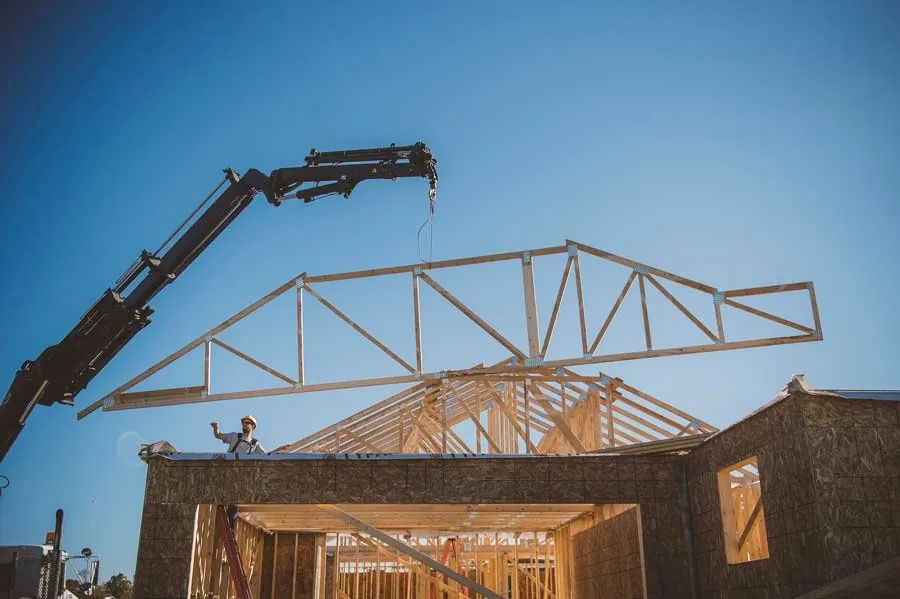
If the kitchen is going under a new or extended roof, it stops being an accessory project and becomes an addition. That reframing matters for budget, schedule and permitting, and it is covered in more detail under home additions.
Permits in Hernando, Pasco and Citrus County
An outdoor kitchen with gas, electric and plumbing is not one permit. It is a building permit for the structure plus separate trade permits, and each has its own inspection.
Hernando County's building fees follow the schedule adopted under Building Fee Resolution No. 2026-037, with residential building fees calculated per square foot and separate electric, plumbing, mechanical and gas fees, including a specific category for L.P. or natural gas permits. Pasco and Citrus run their own schedules and their own review timelines. The fees themselves are rarely the issue. The schedule is.
Three things to verify before design is finalized, because all three can invalidate a layout after the fact:
- Setbacks: Rear and side setbacks apply to accessory structures, and a covered outdoor kitchen counts. A layout drawn against the property line may not be buildable.
- Impervious surface and lot coverage: Adding slab plus roof can push a lot past its permitted coverage, particularly on the smaller lots common in Spring Hill.
- HOA architectural review: Independent of the county, and typically the longest lead time in the whole process. Submit it in parallel with design, not after permitting.
One more item specific to Florida: verify flood zone before designing anything with a slab and utilities. In coastal Hernando, Pasco and Citrus, flood zone designation drives elevation and construction requirements, and it is far cheaper to know at the sketch stage.
A Realistic Line-Item Budget for a Mid-Range Build
Here is how a covered, 16-foot L-shaped outdoor kitchen with a grill, side burner, prep sink and refrigeration typically distributes. Percentages, because the total moves with site conditions:
- Appliances, 20% to 30%: The visible spend, and the only line where the homeowner fully controls the number.
- Cabinetry, structure and counters, 25% to 35%: Masonry or marine-grade framing, doors and drawers, and the countertop material chosen above.
- Utilities: gas, electric and plumbing, 15% to 25%: Highly site-dependent, and the reason two identical kitchens on two different lots quote $8,000 apart.
- Slab and site work, 10% to 15%: Excavation, base, pad, drainage, and restoration of anything the work disturbed.
- Roof or cover, 15% to 30% when included: Structural, engineered and permitted. This is the line that separates a $28,000 project from a $48,000 one.
- Permits and design, 3% to 8%: Trade permits, plan review and engineering where a structure is involved.
Add a contingency of 10% and mean it. On outdoor work the two most common overruns are unknown subsurface conditions and an electrical panel that turns out to have no room, and neither is visible from the driveway on estimate day.
Four Decisions That Move the Total Most
- Where it sits relative to the meter, the panel and the drain: Distance is money in three trades simultaneously. Moving a layout 15 feet closer to the house can save more than downgrading every appliance.
- Whether it is covered, and by what: The single largest swing in the budget, and the largest swing in how often the kitchen is actually used.
- Whether the sink is real: A sink with a legal drain pulls plumbing into the project. A beverage station with an ice bin does not. Homeowners who rarely prep outdoors often pay for a sink they use twice a year.
- Whether the design is built or assembled: A masonry or steel-framed structure with a poured pad behaves differently at year ten than a modular kit set on pavers. The kit is cheaper on day one and rarely cheaper at year ten in this climate.
Timeline From First Sketch to First Cookout
A covered mid-range outdoor kitchen in Hernando or Pasco County typically runs three to five months end to end: two to four weeks for design and material selection, two to six weeks for HOA architectural review where applicable, two to six weeks for permitting including trade permits, and four to eight weeks of construction covering slab and cure, structure, utility rough-in, inspections, cabinetry, counters and final trim.
The two schedule killers are HOA review that started late and countertop templating, which cannot happen until the cabinetry is set and typically adds one to three weeks between the visit and the install. Plan around both.
Protech Construction Services builds custom homes, additions and outdoor living spaces across Hernando, Pasco and Citrus counties, licensed as CBC1268979. If you want a real number for your lot rather than a range, call the office at (352) 710-5455 or start through our contact page. Local project considerations are laid out for Brooksville and New Port Richey, and if the outdoor kitchen is part of a larger renovation the scope sits under home remodeling.
FAQ
Frequently Asked Questions
How much does an outdoor kitchen cost in Florida in 2027?
+
How much does the gas line add to an outdoor kitchen?
+
Which countertop material holds up best outdoors in Florida?
+
Do I need a permit for an outdoor kitchen in Hernando County?
+
Should the outdoor kitchen go under the lanai or outside it?
+
How long does an outdoor kitchen project take?
+
Keep Reading
More articles from the Protech Construction blog
Converting a Garage in Florida: Permits, AC, Egress and Why a $20k Conversion Can Cost You Resale
A garage conversion looks like the cheapest square footage you can add to a Florida home. Here is what it really costs in 2026, what the code requires for the slab, AC and egress, and when a $20,000 conversion costs you more at resale than it adds.
Read Article
Screened Porch Additions in Florida: Real Costs for an Attached Screen Room, Not a Pool Cage
Three contractors can quote a screened porch $30,000 apart and all be honest, because they are pricing three different projects. Here is what a roofed screened porch addition really costs in Florida, where the roof tie-in decides the budget, and when a screen room is the better buy.
Read ArticleSunroom and Florida Room Cost in Florida: What the Code Category, Climate Control and Foundation Really Add
Two neighbors both build a sunroom. One spends $25,000, one spends $75,000, and both got a fair price. The difference is a code category almost nobody names during the sales call, and it decides the glass, the foundation, the HVAC and whether the room counts as square footage at all.
Read ArticleReady to Build?
Get your free evaluation today.
No-pressure consultation. We serve Hernando, Pasco, and Citrus counties. Call us now or request a visit online.