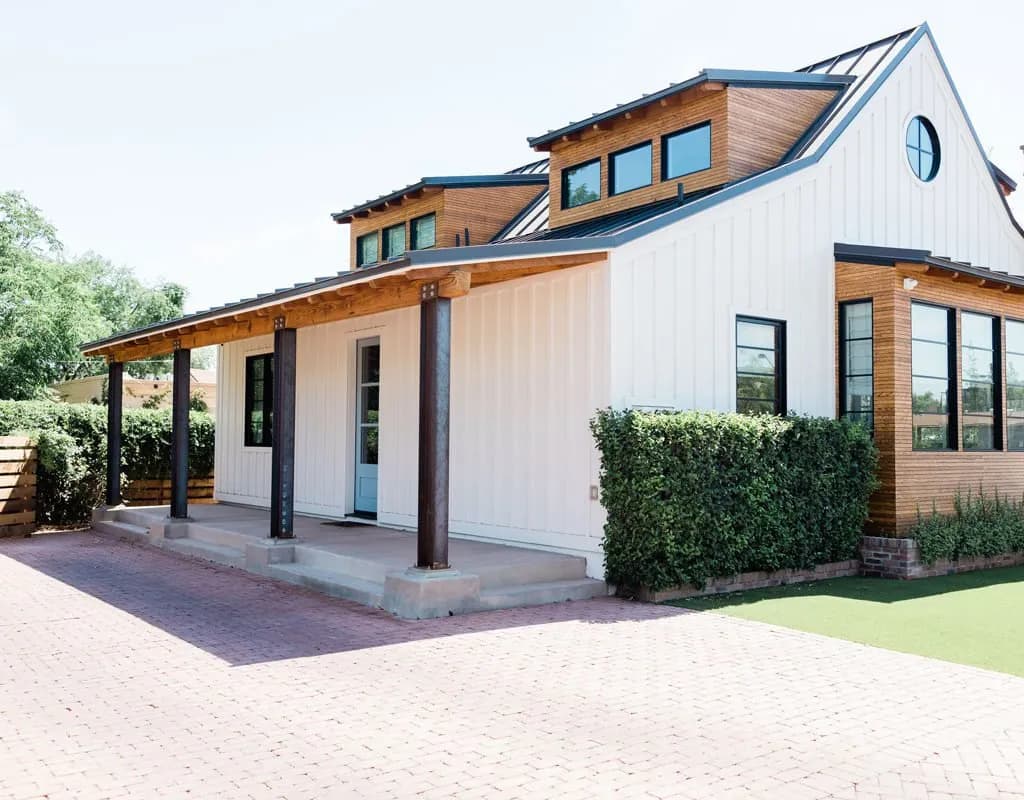
Protech Construction Services LLC (license CBC1268979) builds custom homes and manages remodels across Hernando, Pasco, and Citrus counties from our office at 9035 Jayson Dr in Brooksville, and the roof question comes up on almost every project. On a new build it comes up at the specification meeting, when the difference is a line item on a budget nobody has spent yet. On a remodel it comes up after a storm, when the decision is being made under time pressure. Those are very different conversations with the same underlying math, and the math is more interesting than either side of the usual argument. Metal is not automatically the smart money and shingle is not automatically the cheap answer. What decides it is how long you intend to own the house, what your carrier does with the wind mitigation form, and whether the roof is going on a new frame or replacing something that already failed. This article runs the real 2026 numbers for Florida, shows where the payback comes from and when, and names the cases where we specify shingle without hesitation.
The $14,000 Question, Stated Honestly
Start with the number that actually appears on quotes. In Florida in 2026, a complete metal roof project commonly lands between $15,000 and $35,000, while a quality asphalt shingle roof runs about $7,900 to $15,000. That is the two to three times multiple every homeowner hears. On a typical Hernando County single family home the midpoints work out to roughly $26,000 for standing seam against roughly $12,000 for architectural shingle, so the gap you are being asked to fund is about $14,000.
The mistake is treating that as a $14,000 expense. It is a $14,000 prepayment against three future costs, and the three do not pay back at the same rate.
- Insurance credits: Recur annually, start immediately, and are the largest single channel in Florida.
- Cooling costs: Recur annually, are real but smaller than the marketing suggests, and depend heavily on your insulation.
- The second shingle roof: Pays back in one lump, late, and only if you still own the house when it comes due.
Anyone who tells you the crossover lands on a specific year without asking how long you plan to stay is selling something. The rest of this article separates the three channels so you can run your own number.
What Each Roof Costs in Florida in 2026
Material choice is only half of the price. Roof geometry, pitch, tear-off volume, and deck condition move the total as much as the covering does, which is why two quotes on the same house can differ by thousands without either being dishonest.
- Architectural asphalt shingle: Roughly $7,900 to $15,000 for a quality installation on a typical Florida home. The most common price in this region, the fastest to install, and the easiest to get material for on short notice.
- Exposed fastener 5V metal: Roughly $6 to $9 per square foot, which prices remarkably close to good shingle. This is the panel that makes the metal argument accessible, and it is very common on Florida rural and agricultural-style homes.
- Standing seam metal: The upper end of the $15,000 to $35,000 band. Concealed fasteners, cleaner detailing, longer service life, and the profile most people picture when they say metal roof.
- Deck and structure: Priced separately on a replacement and included in the build on new construction. On a re-roof this is the line that grows after tear-off, and it should be quoted per sheet before you sign anything.
One planning note that matters more on a remodel than on a new build. Metal is dramatically lighter than tile and comparable to shingle, so on most Florida homes there is no structural upgrade required to switch. The weight objection belongs to the tile conversation, not this one.
Lifespan Is the Number That Reframes the Whole Comparison
Everything downstream of this section depends on one fact: in Florida heat, humidity, and ultraviolet, asphalt shingle commonly delivers 15 to 20 years of service, while metal commonly delivers 40 to 60, with well specified systems cited as high as 70.
Put that on a 40 year ownership horizon and the comparison stops being roof against roof. It becomes one metal roof against two, sometimes three, shingle roofs, each one carrying its own tear-off, its own disposal, its own permit, and its own price at whatever labor and material costs happen to be in that year. The second shingle roof is not a hypothetical. It is a scheduled expense with a date on it.
The honest counterweight is that most people do not own a Florida home for 40 years. If the plan is to sell inside a decade, the second shingle roof never becomes your problem, and the payback argument narrows to insurance and energy alone. That is a legitimate reason to choose shingle, and we say so on projects where the owner is clear about the horizon.
Insurance: Where the Metal Premium Actually Comes Back
This is the channel that moves the most money in Florida, and it is the one most homeowners underestimate because the savings arrive quietly on a renewal rather than as a check.
Metal, built-up, and membrane roof systems are called out by name on the Florida wind mitigation inspection form, and many carriers offer 15 to 35 percent premium reductions for metal or impact-resistant roofing. On a $4,000 annual policy that is $600 to $1,400 per year, every year, for the life of the roof. Over a 40 year metal service life the same discount range totals $24,000 to $56,000 in avoided premium, which is several times the original gap.
Two specifics decide whether you land at the top or the bottom of that band.
- The form changed on April 1, 2026: Wind mitigation credits are now documented on the revised OIR-B1-1802 form, revision 04/26. Schedule the inspection after the roof passes final, because every credit is verified on the completed assembly.
- Roof covering credit: The installed covering has to meet current Florida Building Code standards, documented with Florida Product Approval or Notice of Acceptance numbers. This item alone commonly carries 5 to 10 percent of the wind premium, and it is available to a properly specified shingle roof too, since shingles meeting ASTM D3161 Class F or ASTM D7158 Class H qualify.
- Roof deck attachment: Graded on fastener type, length, and spacing. Decking nailed with 8d common nails of at least 2 1/4 inches at 6 inches on center on the edges and 12 inches in the field earns the intermediate credit. This is a framing decision, not a roofing decision, which is exactly why it is easier to get right on a new build.
- The full package: Homes combining hip geometry, impact-rated openings, upgraded deck attachment, and secondary water resistance commonly see 20 to 30 percent off the total annual premium.
Read that list again with a builder's eye and the real conclusion appears: a large share of the insurance benefit is decided by the deck, the geometry, and the openings rather than by the covering. Metal helps. Metal on a poorly attached deck helps less than most people assume. We walk this whole list at design stage on every custom home build, and the wind code side of it is covered in depth in our guide to the Florida hurricane wind code for new homes.
Energy: Real Savings, Smaller Than the Brochure
Metal roofing marketing tends to promise a transformed power bill. The measured research is more modest and more useful.
Light colored metal with a reflective coating can reflect a large share of incoming solar radiation and commonly runs attic temperatures 20 to 30 degrees cooler than a dark conventional roof. Monitored and modeled studies of reflective roofing put the cooling energy reduction at roughly 12 to 25 percent in homes, with averages landing near 20 percent, and industry figures for reflective metal systems generally cite 10 to 25 percent against dark asphalt.
Translate that to dollars carefully. Cooling is a portion of a Florida electric bill, not the whole bill, so a 20 percent cut in cooling energy is not a 20 percent cut in what you pay. On a typical Hernando County home the realistic annual saving from the roof alone lands in the low hundreds of dollars, not the thousands. It is real money and it recurs, but it is the smallest of the three channels.
The bigger lever is the assembly under the roof rather than the roof itself. Attic insulation depth, air sealing at the ceiling plane, and duct location do more for a Florida cooling bill than the color of the panel above them. If energy performance is the actual goal, the roof is one line on a longer list, and we break that list down in our energy-efficient Florida home guide.
Wind and Code: What Each Assembly Is Rated For
Wind rating is where the two products separate on paper. Standing seam metal systems are commonly rated at 140 to 150 mph and above. Architectural shingles typically sit at 110 to 130 mph. In a state where large areas of the Gulf and Atlantic coasts run design wind speeds between 140 and 160 mph for Risk Category II structures, that difference decides which products are even eligible at a given address.
Two points that get lost in the brochure comparison. First, the rating belongs to a tested configuration rather than to the material, so the underlayment, the fastener pattern, and the edge metal are part of what was approved. A metal panel installed outside its tested configuration is not a 150 mph roof. Second, every covering installed in Florida has to carry a current Florida Product Approval or a Miami-Dade Notice of Acceptance rated for the design wind speed at your specific project address, not the county average.
For a builder this is a specification discipline question rather than a product preference. The approval number belongs on the plan set, and the inspection sequence of nail-off, dry-in, and final is what verifies it got built the way it was drawn.
The Payback Math, Run Three Ways
Here is the arithmetic, using the $14,000 gap and the ranges established above. No single answer fits every house, so run the version that matches your situation.
- Best case, top of the insurance band: $1,400 per year in premium credit plus roughly $300 per year in cooling savings is $1,700 annually. The $14,000 gap closes in year 9. This is the scenario behind the claim that metal pays for itself in under a decade, and it requires a carrier at the generous end and a home that actually earns the full credit.
- Middle case, mid band: $1,000 per year in premium credit plus $250 in energy is $1,250 annually. The gap closes around year 12. This is where most Hernando County homes with a well specified roof actually land.
- Conservative case, bottom of the band: $600 per year in premium credit plus $200 in energy is $800 annually. On recurring savings alone the gap does not close until roughly year 18. But that is also the window in which the shingle roof would have been replaced, so the avoided second roof closes the gap at almost exactly the same moment from the other direction.
That convergence is the honest headline. At the top of the range metal pays back through insurance in about nine years. At the bottom of the range it pays back through not buying a second roof in about eighteen. There is no realistic set of Florida numbers where a properly specified metal roof fails to break even inside a typical 20 year hold, and there are many where it happens in half that.
What breaks the math is a short hold. Sell in year five and you captured five years of credits and none of the replacement avoidance. In that case the relevant question is resale rather than payback, which is a different calculation with a different answer.
Where Shingle Is Still the Right Answer
We specify shingle on real projects and we do not treat it as a compromise. Four situations make it the correct call.
- Short ownership horizon: If the plan is to sell within five to seven years, the recurring credits alone rarely justify the gap, and the buyer prices the roof on age rather than on material.
- Deed restrictions and neighborhood context: Some communities restrict metal profiles or colors outright, and a home that reads as visually out of place on its street has a resale problem no energy saving offsets.
- Complex roof geometry: Metal rewards simple planes. A roof with many valleys, dormers, hips, and penetrations multiplies the flashing detail, which raises both the price and the risk of an installation error. Shingle is far more forgiving of complexity.
- Budget timing on a rebuild: After a storm, with a deductible already paid and a family out of the house, spending an extra $14,000 to buy back money over 12 years is not always the right household decision. That is a cash flow judgment, not a roofing one.
The one thing we do not compromise on in either case is the deck and the fastener schedule underneath. A properly attached deck earns credits regardless of what goes on top of it, and it is the part of the assembly that cannot be improved later without tearing the roof off again.
What Changes When It Is New Construction
Everything above assumes a replacement. On a new build the economics shift in metal's favor for reasons that have nothing to do with the roof itself.
There is no tear-off and no disposal, which removes a meaningful chunk of what makes a metal re-roof expensive. The deck attachment schedule is being specified from scratch, so the intermediate or superior credit is a drawing decision rather than a retrofit. Roof geometry is still on paper, which means a simple hip roof with fewer penetrations can be designed in, and hip geometry is itself a wind mitigation credit. And the cost difference gets folded into a construction loan at mortgage rates rather than paid from savings or financed on a home improvement product.
The result is that the same $14,000 gap feels materially different. Spread across a 30 year mortgage it is a small monthly figure, while the insurance credit lands in full from the first renewal. That is the single strongest version of the metal argument, and it is only available at design stage. It is one of the specification conversations we have before pricing on every build in Hernando County and Pasco County, alongside the site work and impact fee questions covered in our Hernando County cost-to-build guide.
Noise, Hail, Resale and the Other Objections
Four objections come up on nearly every metal conversation and all four deserve a straight answer.
- Noise: The rain-on-a-tin-roof association comes from bare panels over open framing on a barn. A residential metal roof sits over solid decking, underlayment, and attic insulation, and measured differences against shingle inside a finished home are minor.
- Hail: Metal can dent under large hail while continuing to perform. Asphalt loses granules, which is functional damage rather than cosmetic. Florida hail exposure is low compared with the plains states, so this objection carries less weight here than the internet suggests.
- Lightning: Metal does not attract lightning. It is non-combustible, which is a modest advantage rather than a risk.
- Resale: A new roof of either type helps a Florida listing, because buyers and their carriers price roof age directly. Metal adds the additional argument that the buyer inherits decades of remaining life and the associated insurance treatment, which is a real talking point in a market where insurability decides whether a deal closes.
Worth noting for anyone weighing a replacement rather than a new build: our sister company Protech Roofing handles roof replacement and insurance claim work across this region, while Protech Construction handles the build, the addition, and the structural side.
How We Specify This on a Protech Build
The order we work in is deliberately not material first. It goes horizon, then geometry, then deck, then covering.
We ask how long the family intends to own the home, because that single answer moves the payback calculation more than any product choice. We look at roof geometry next, because hip versus gable is both a wind mitigation credit and the variable that decides how well metal detailing will work. We set the deck attachment schedule to earn the credit at framing, since that is the part nobody can improve afterward. Only then does the covering get chosen, and by that point the decision is usually obvious from the numbers rather than a matter of taste.
If you are planning a build or a major remodel and want this run against your actual plan, lot, and insurance situation, we do that before quoting anything. See the full home remodeling and custom build process, browse the floor plans, call (352) 710-5455, or start on the contact page.
FAQ
Frequently Asked Questions
Is a metal roof worth it in Florida compared to shingles?
+
How much does a metal roof cost versus a shingle roof in Florida in 2026?
+
Does a metal roof lower home insurance in Florida?
+
How long does a shingle roof actually last in Florida?
+
Do metal roofs really reduce cooling costs in Florida?
+
When should I choose shingles instead of metal on a Florida home?
+
Keep Reading
More articles from the Protech Construction blog
Elevated and Piling Home Cost in Florida: 2026 Guide
The flood zone tells you how high the floor has to be. It does not tell you what that height costs, and the numbers floating around the internet are off by a factor of three. Stem wall runs about $5 per square foot over slab on grade. A complete piling foundation runs $50,000 to $90,000, which on a 2,400 square foot home is closer to $31 per square foot than the $100 to $150 figure commonly quoted. Here is the honest breakdown, foundation by foundation.
Read Article
Multigenerational Home Layouts in Florida: 6 Plan Moves
Nearly every production floor plan in Central Florida is a split-bedroom 3/2 designed for a nuclear family, and dropping three generations into it fails in predictable places: one shared wall, two bathrooms, one thermostat, and a great room that everyone has to walk through. Here are the six plan decisions that actually buy privacy, what each one adds to a build budget, and the single line in Florida statute that turns a suite into a second dwelling unit.
Read Article
Aging-in-Place Home Design in Florida: 2027 Cost Guide
No building code forces accessibility into a single-family home in Florida. That is exactly why the decisions get skipped, and why the same nine items come back later at ten to fifty times the price. Here is the build-now versus retrofit-later math, item by item.
Read ArticleReady to Build?
Get your free evaluation today.
No-pressure consultation. We serve Hernando, Pasco, and Citrus counties. Call us now or request a visit online.